Studio Note
Where AI Belongs in Our Pipeline
A short, honest note for the developers, shipyards, brokers, and design offices we work with — on how we actually use AI at Mosh, what it earns its place doing, and what still gets rendered the traditional way, frame by frame.

Arwen 113m — a hero exterior. This kind of image is still built and lit shot-by-shot. AI doesn't make it; AI extends it.
Clients ask us about AI more than they ask about any other single topic — often before they ask about scope, price, or delivery. That tells us the conversation has moved faster than the industry has been willing to talk about openly. So here is where we actually stand, without the marketing language.
01 · The Decisions Are Still Human
Nothing in our pipeline decides what a project should look like except the people making it. AI gives our artists more directions to react to and more variations to compare. It does not choose which one is honest to the yacht, which one flatters the villa, which one will move an owner. That judgment sits where it always has — with the artist holding the file. If anyone ever tells you their pipeline is fully automated, they are either bluffing or they are shipping work you would not want your name on.
02 · The Hero Shot Is Still Made By Hand
The single image that carries a project — the master exterior, the owner's suite, the VVIP dining cabin, the podium shot of the tower — is still built in a traditional CGI pipeline. Real geometry, real lights, real material shaders, real render time. Pure text-to-image AI cannot yet hold pixel-level accuracy across a brand-critical asset that has to survive twelve rounds of revision from a completions centre, a broker, and a lead architect. It looks close in isolation. It falls apart on the third change request.
03 · Where AI Actually Earns Its Place
AI does the work that surrounds the hero. Once an environment is built and signed off, we can spin it into dawn, dusk, overcast, and rain. We can populate the terrace with guests, switch a fabric palette, drop a hero interior into a social cutdown, or extend a still frame into a short motion loop for a broker deck. The creative direction is already locked, so the studio is no longer starting each variant from scratch. For a launch campaign that has to run eighteen months, that changes the economics of every asset you have already paid us to build.

Palm Villa loggia. One approved environment, many downstream assets — day, night, staged, un-staged, hero still, social cut.
04 · Cheap On Day One, Expensive On Revision Three
AI outputs are probabilistic. The same prompt does not produce the same image twice, and a client note like keep this exact frame, just swap the sofa is where a lot of AI-first pipelines quietly collapse. The right question to ask any studio is not can you make this cheaper with AI. It is what happens when I want to change one thing. Our answer is that anything a client will need to revise lives inside the traditional 3D scene, where a change is a change and not a re-roll.
05 · The Infrastructure Matters More Than The Model
Models commoditise. What separates a studio with AI under control from a studio using AI casually is everything underneath the model — version control on generated frames, per-project cost tracking, audit trails, seed and prompt logging, a clear boundary between what was rendered and what was assisted. That governance layer is unglamorous and it is what keeps a project reproducible two years after delivery, when a broker asks for a new cutdown of the same suite.

AirX VVIP dining. Certified fixtures, matched veneers, and real material specifications — the kind of scene AI can extend but not originate.
06 · Three Questions Worth Asking Any Studio
We would rather clients arrived with sharp questions than a fixed brief. Ask any studio you shortlist:
- Where in my project will you use AI, and where won't you? Tests whether they think about it deliberately or reach for it by default.
- How do you handle revisions on AI-assisted frames? Tests whether the pipeline can survive real client feedback.
- Can you show me a recent project and point to what AI did on it? Tests whether they actually track it, or whether the answer is a slogan.
07 · Brief On Outcomes, Not Deliverables
This is the biggest change in how to work with a studio in 2026. Old briefs specified outputs — three exteriors, six interiors, one film. Better briefs specify what the content is for — the buyer, the moment, the channel, the length of the campaign. AI gives us the freedom to shape the format around the outcome instead of the other way around. Tell us the launch you are trying to win and we will come back with a sharper answer than if you hand us a shot list.
The Bottom Line
The category has moved quickly and it will keep moving. The best work is being made by studios that have taken AI seriously as a tool and just as seriously as a governance problem. The worst is being made by studios that treat it as a shortcut. You do not need to become an expert to commission us. But the questions you bring will change the value you get out of every project — and we would rather have that conversation up front than at the end of the second revision.
If you want to see how this plays out in practice, our selected works are the honest answer to what we are willing to put our name on today.
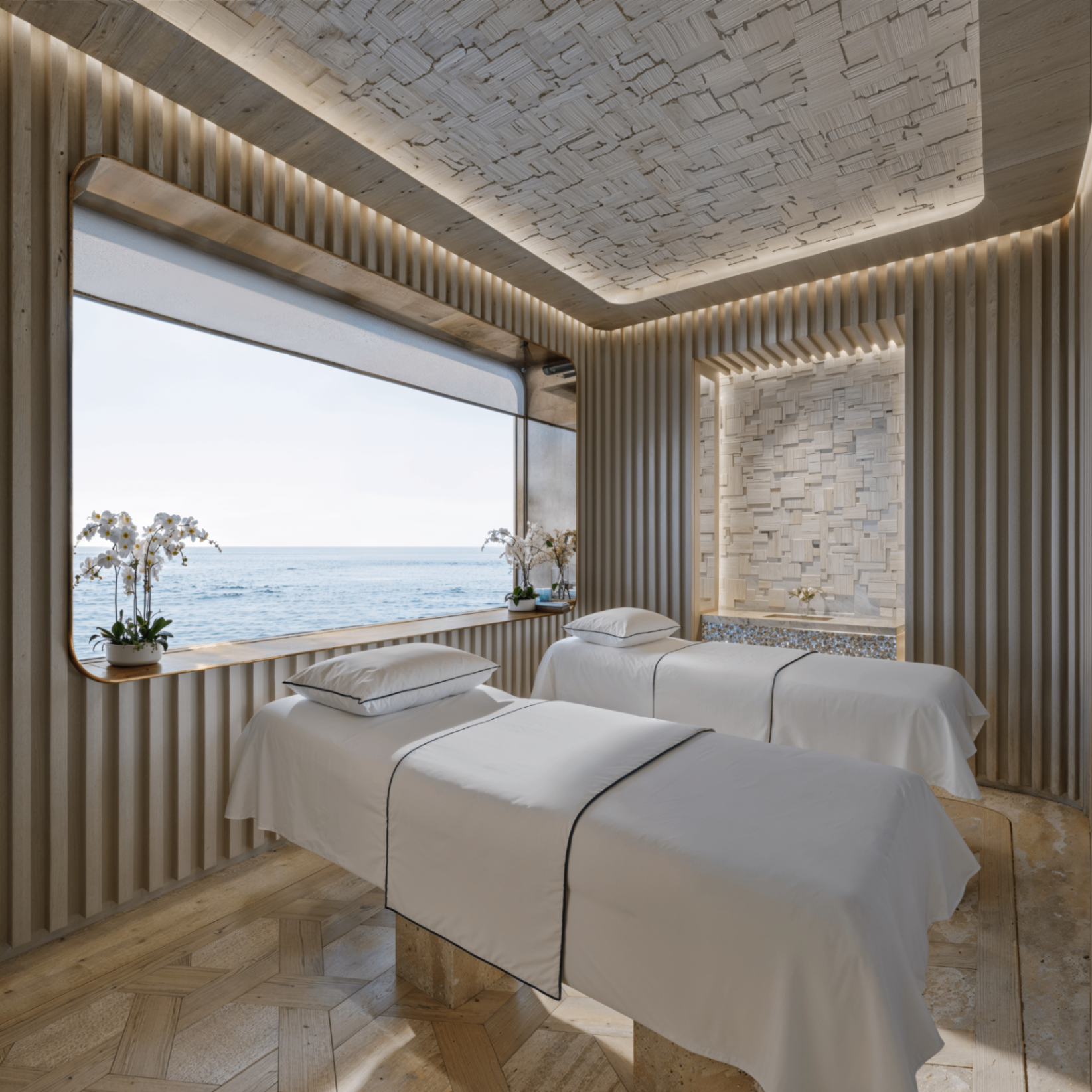
Arwen spa suite. The craft still shows up in the small decisions — where the light falls, how the stone reads, what the eye lands on first.