Builder Guide · 9 min read
3D boat rendering vs yacht rendering — what custom builders really need
The two disciplines share software and craft, but the deliverables that sell a 12 m sportfisher are not the deliverables that sell a 90 m superyacht. Here is how we scope, model, light, and animate each — and where a custom builder should invest.
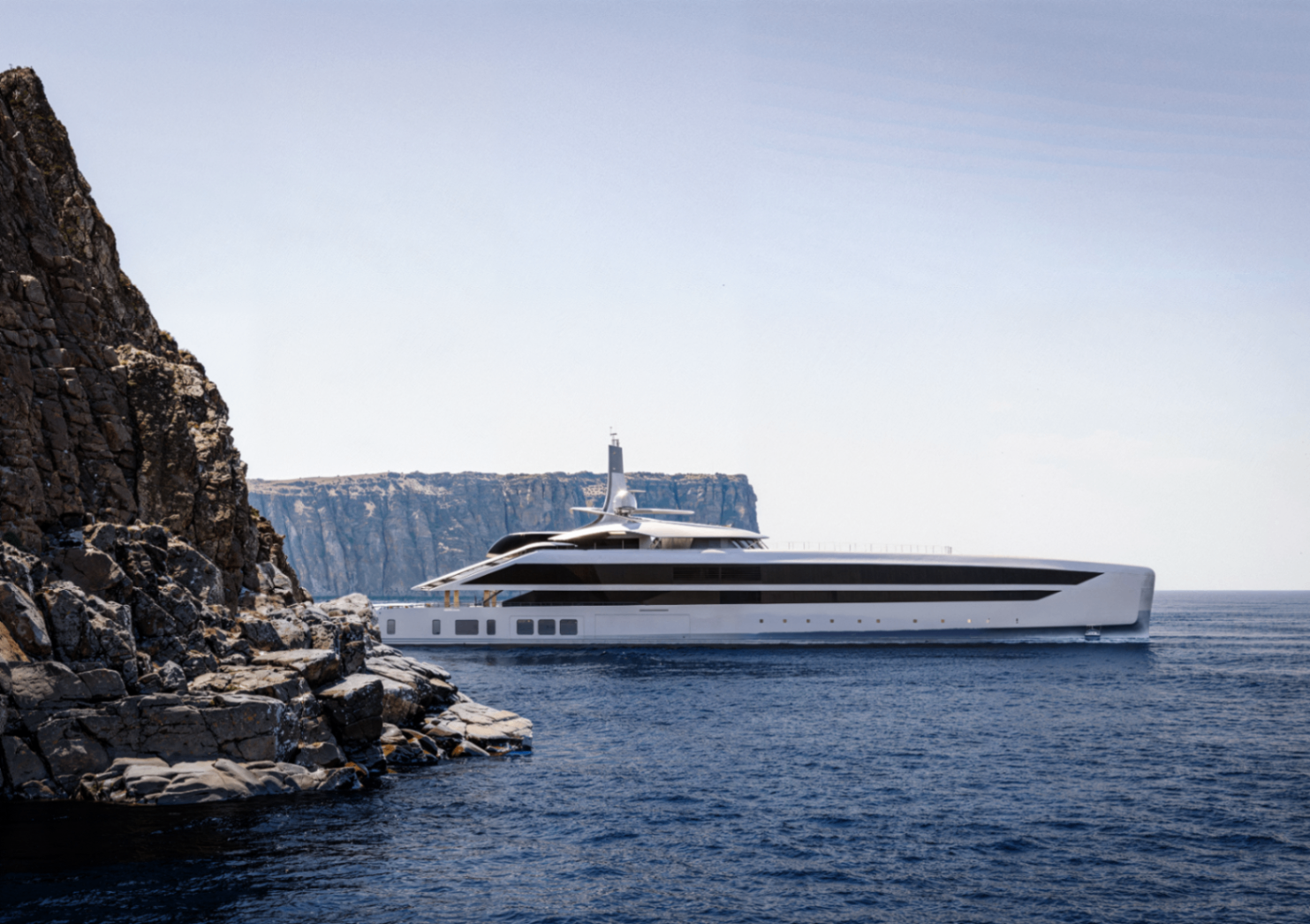
Where the two disciplines split
“3D boat rendering” is a broad discipline that covers every hulled vessel a studio might visualize — sportfishers, day boats, tenders, catamarans, expedition vessels, and everything short of what the market calls a superyacht. “Yacht rendering” is the narrower luxury slice: 30 m and up, custom interiors, multi-deck exteriors, brokerage-grade cinematography.
The technical craft is the same — accurate hull geometry, honest materials, physically based lighting — but the emphasis shifts. Boat rendering rewards precision on hull form and running attitude; yacht rendering rewards interior storytelling and cinematic exterior beats.
Hull modelling and running attitude
For custom boat builders the hull is the product. We work from your CAD (Rhino, SolidWorks, or class-society NURBS files) and preserve chine lines, spray rails, and transom detail exactly. Wake, spray, and trim angle are simulated to match the vessel’s actual planing behaviour — a 32 kt sportfisher does not sit like a 12 kt trawler, and buyers who know boats notice immediately.
Superyacht work leans the other way. The hull is still exact, but most of the effort goes into the topsides, glazing reveals, and the way daylight moves across the superstructure through a full day cycle.
Lighting and environment
Boat renderings live outdoors — open water, marina light, sunset trials. We build HDRIs that match the intended cruising ground (Med, Caribbean, UAE coast) so the vessel reads correctly on paper and on a broker’s phone. Yacht renderings add long interior passages — saloons, master suites, spa decks — where lighting must resolve marble, leather, and stitched upholstery under both daylight and evening scenes.
Deliverables that sell each vessel
A custom builder typically needs a compact package: three exterior hero angles, a beam profile drawing plate, a running shot, and a 20–30 second sea-trial loop for social. That combination gives the sales team enough to pitch, quote, and post — without paying for interior work the buyer will spec themselves.
A superyacht package looks different: 15–25 stills across exterior and interior, a 60 to 90 second cinematic film, brokerage-safe reframes for print, and often a walk-through animation for owner review. The cost gap between the two is not about quality — it is about volume and interior scope.
When to commission which
If you build production or semi-custom boats under 24 m, invest in 3D boat rendering early — before hull tooling is finalised, so you can trial cabin layouts and colour options against real light. If you are contracting a full-custom yacht above 30 m, expect a longer visualization programme aligned to the interior design milestones.
Both start with the same short call: what is the vessel, who is the buyer, and where will the imagery live. That conversation decides everything downstream.
Talk to us about a boat or yacht visualization brief — we work with custom builders in the UAE, Europe, and North America.