Studio Strategy
Offshore 3D Architectural Visualisation — A London Firm's Guide
How London and European architectural firms should evaluate an offshore partner for high-end CGI — the technical and governance checks that separate a genuine studio from a rendering shop.
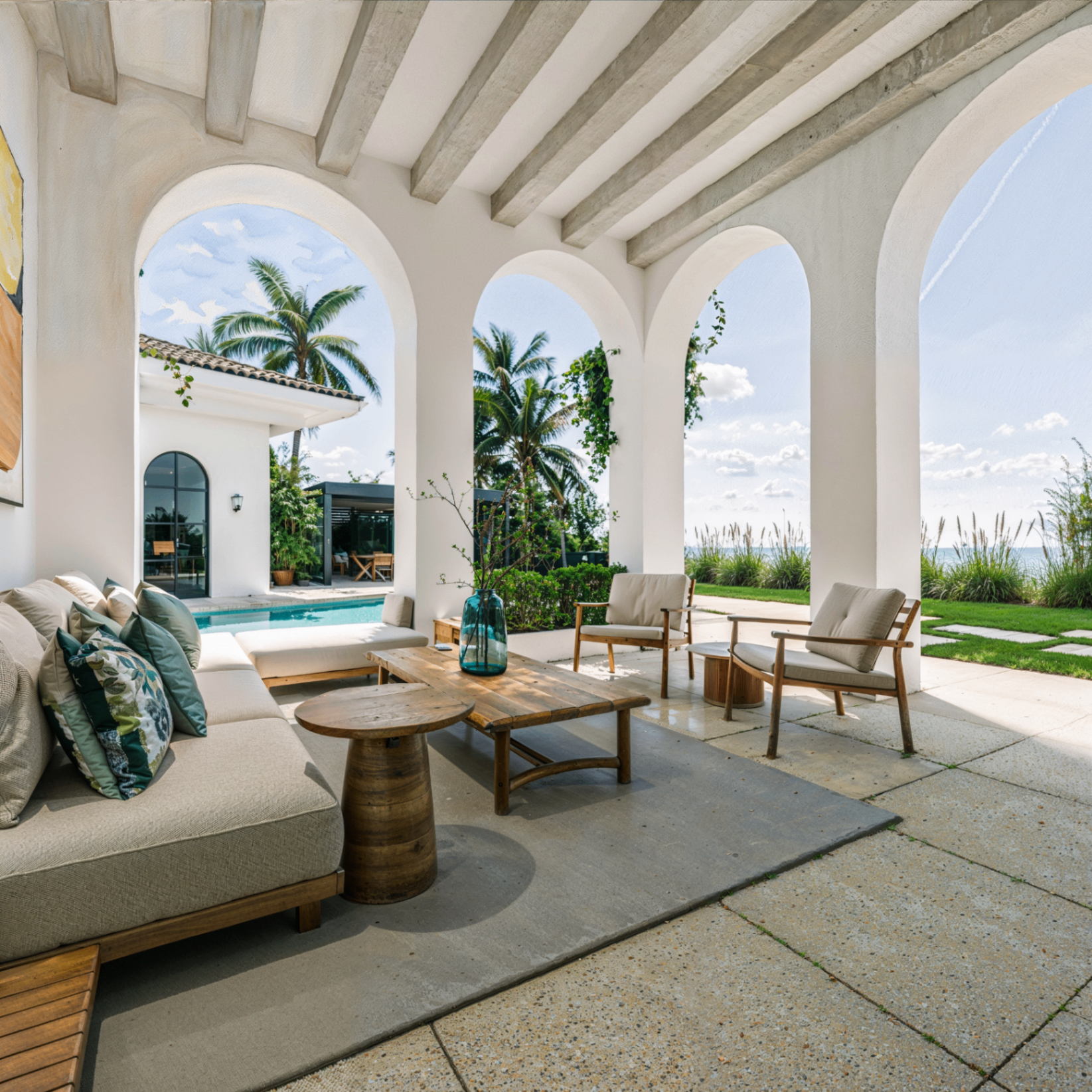
Palm Villa loggia — high-end residential architectural visualisation delivered from the studio's Dubai floor for a London-based practice.
Offshore 3D architectural visualisation is now the norm for London and European architectural firms working on high-end residential, hospitality and mixed-use schemes. The economics are simple — CGI production costs in London have risen faster than fees — but the decision is not really about hourly rate. It is about whether an offshore partner can carry the technical precision, material fidelity and studio governance that the practice's own directors would sign off on. This is the framework we use, and see used, when firms evaluate an offshore visualisation studio.
Why Firms Look Offshore in the First Place
A London practice pays for two things when it commissions visualisation: the render itself, and the studio capacity to turn revisions around during a live design and marketing cycle. In-house CGI teams solve the second problem but bind the first to a permanent salary and pipeline overhead. Freelance visualisers scale the first but rarely absorb enough parallel work for a launch. An offshore studio, when chosen carefully, gives both — a permanent bench of senior artists at a marginal cost that London simply cannot match, without giving up review cadence.
The risk is that "offshore" also covers a spectrum from boutique studios with senior leads and colour-managed pipelines, to production floors that quote by the image and subcontract the work invisibly. The evaluation framework below is designed to separate them before a project is committed.
Technical Precision — What to Actually Test
Portfolios sell atmosphere. Technical precision is a different check. Before commissioning, ask a prospective offshore partner to walk through a single completed image at the level of detail a technical director would care about. A capable studio will be able to answer, on the spot:
- Source model. Which CAD or BIM format the scene was built from, how it was cleaned, and how updates from the architect were merged during the project.
- Camera and lens. Focal length, sensor size, and why that framing was chosen for the brief. Vague answers here usually signal a stock camera library rather than considered composition.
- Lighting setup. Real geographic sun position for the site, sky model in use, and how interior artificial light was balanced against daylight rather than dropped in at post.
- Colour pipeline. Whether the studio works in linear space with an ACES or equivalent colour transform end to end, and how they proof against the client's viewing environment.
- Render engine and version. A production studio can name the engine, the version, and the reason for choosing it. A rendering shop cannot.
Material Resolving — The Real Quality Gate
Almost every visible difference between a good and a bad high-end render sits in the materials. Grain direction on sawn oak, the sheen of unlacquered brass, the slight translucency of onyx, the way linen sits under raking daylight — these are not preset choices, they are studio craft. When testing an offshore partner, do not judge them on hero images. Judge them on the hardest material in the brief.
A useful exercise before committing to a full package is to send one physical sample — a fabric, a stone, a veneer — and ask for a small standalone render of that material under two lighting conditions. Studios that can resolve material correctly will return something you would be comfortable presenting to a client. Studios that cannot will return something that looks generically expensive but does not match the sample. The gap is obvious and it will only widen at project scale.
Governance, Review Cadence and Time Zones
A visualisation project fails when review rounds stall, not when a single render is imperfect. The offshore relationship has to be built around the practice's review cadence, not the other way around. In practice this means a working overlap window with London of at least three to four hours, a single named studio lead who attends the design team calls, and a review platform where markup is versioned rather than sent as loose PDFs.
Dubai works particularly well for London and European firms on this axis. The working day overlaps generously with UK office hours; the studio timezone is close enough that a morning brief in London becomes an afternoon test render the same day; and the market rewards senior CGI talent, so studios there routinely hold artists at a level that London firms would struggle to retain in-house at comparable cost.
IP, NDAs and Handling of Confidential Schemes
For competition entries, off-plan launches and private residential work, the offshore studio is handling material that cannot leak. A serious partner will sign a proper NDA, restrict the project to a named team, and confirm where models and assets are stored. Cloud rendering on shared consumer render farms is not appropriate for confidential schemes. Ask the question directly — a studio worth working with will already have the answer.
A Practical Vetting Checklist
Before signing an offshore visualisation contract, work through the following. Any one gap is a warning; two or more usually means the studio is not right for high-end work.
- A single-material test render, delivered from a supplied physical sample.
- A walk-through of one previous project at technical director level — model, camera, lighting, colour.
- Named studio lead and a working-hours overlap with the practice.
- Version-controlled review platform and a defined revisions policy.
- A signed NDA and clarity on where models and renders are stored.
- References from at least one London or European practice the studio has delivered for.
Working With Mosh Design
Mosh Design runs its production floor in Dubai and works regularly with London and European architectural, interior and yacht design practices. The studio handles residential, hospitality and yacht CGI end to end — from CAD or Revit handoff through material resolving, lighting studies, review rounds and final delivery.
See our architectural visualisation services, explore our yacht and marine visualization work, read the studio process guide, or brief us on a specific project to receive a scoped estimate.