Motion Study
Yacht Animation Essentials
A technical guide to cinematic sea-trial animation for superyachts — hull motion, camera choreography, and material physics that hold up frame by frame.
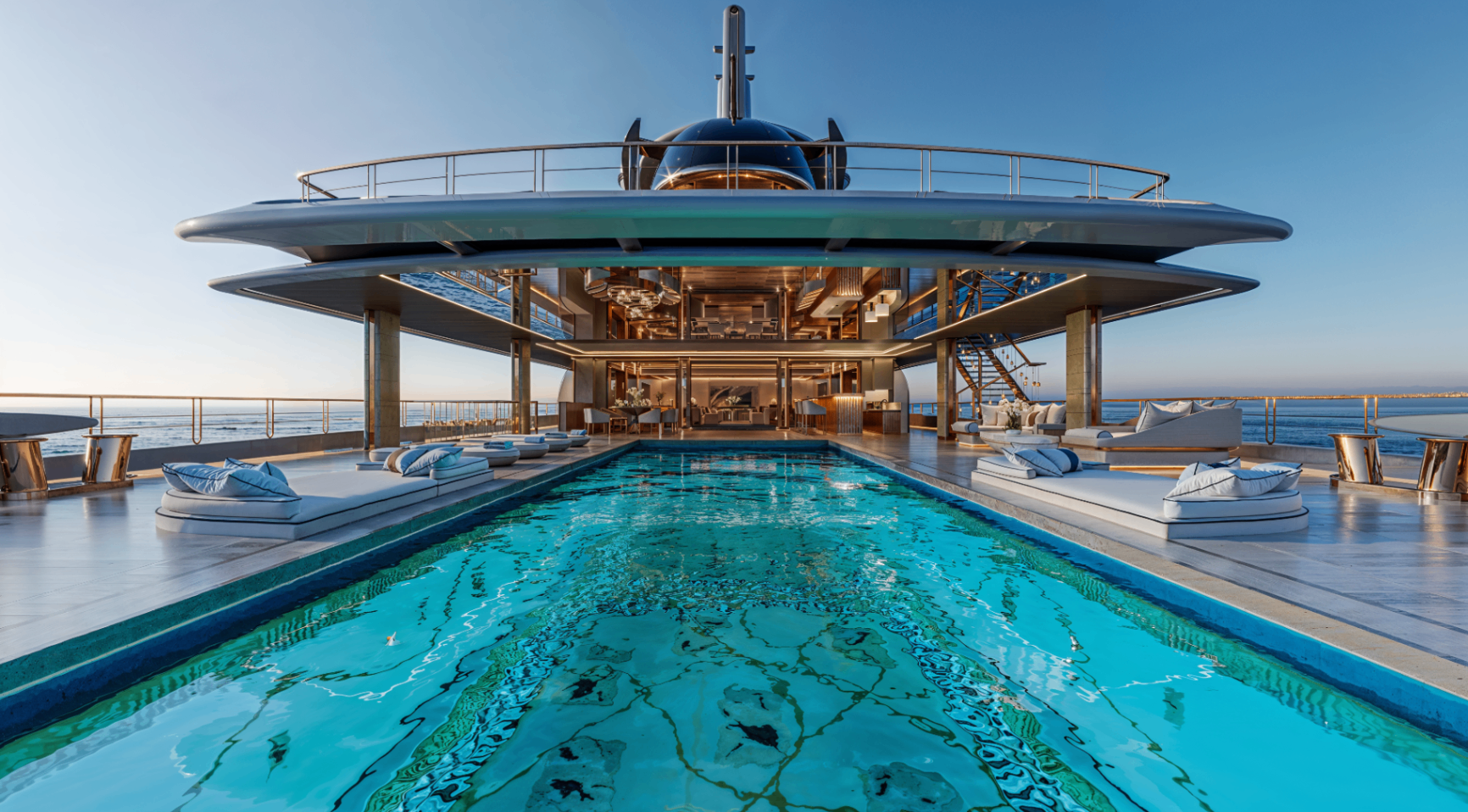
Sea-trial fly-around — a single continuous camera move designed to read hull, sheer, and superstructure in one breath.
A still render can flatter a yacht. Animation cannot. The moment a hull begins to move, every simplification you took during modelling — a shortcut on the waterline, a lazy reflection on the topsides, a rig that only reads at one angle — becomes visible. Cinematic yacht animation is essentially a stress test for the entire visualization pipeline, and the workflow has to be designed around that pressure from the first shot list onward.
Sea-Trial Choreography
A cinematic sea-trial is not a single shot. It is a sequence of decisions about how the vessel enters, occupies, and exits the frame. We storyboard three anchor moments first — the establishing wide, the signature beauty pass, and the closing aft-quarter departure — and only then decide how the camera travels between them. Each move exists to answer a specific question: what does this yacht feel like at speed, how does the superstructure hold together at the quarter, how does the helipad read from above.
Camera work is anchored to the hull rather than the world. A drone-style parallax around the bow reads as marketing spectacle; a locked-on tracking shot from a chase-boat height reads as documentary trust. Most sea-trial films need both, cut against each other so the audience understands the yacht as an object and as an experience in the same minute of footage.
Hydrodynamic Motion
The single most common failure in boat animation is a hull that floats on top of the ocean instead of through it. Real displacement produces a bow wave, a quarter wave, and a turbulent wake — and each of those interacts with the hull geometry differently depending on speed, heading, and sea state. We drive the water simulation from the yacht's actual displacement figures and cruising speed, then art- direct the sea state to match the emotional register of the shot: a glassy Mediterranean morning for launch films, a short-period Atlantic chop for capability films.
Hull motion itself is layered. Pitch and heave respond to the incoming wave train; roll responds to beam-on swell; yaw is dictated by heading changes. Baking all three into a single procedural rig lets the animation team keyframe the yacht's path across the water and get physically plausible motion for free — no more manually counter-animating a hull that keeps sliding through a wave crest.
Material Physics in Motion
Materials that survive stills often break in animation. Wet topsides need a thin-film water layer that beads, sheets, and drains at speed. Polished stainless has to catch the sun differently on every frame as the hull rolls. Teak decking darkens where spray lands and lightens as it evaporates. None of this is optional in a cinematic edit — the eye notices when a hull sails through a wave and comes out with the same reflectance as before it entered.
Glass is the hardest surface. Salon glazing has to render interior detail, exterior reflection, and refracted horizon simultaneously, and every one of those layers moves at a different rate as the camera flies past. We split the glass into a separate render layer with its own IOR, thin-film coating, and Fresnel curve, then recomposite it so the grade can push each element independently in post.
Frame-Rate, Motion Blur & Shutter
Sea-trial films are almost always finished at 24fps for the cinematic register, with select capability shots delivered at 60fps for social. Motion blur is rendered per-sample at a 180-degree shutter — a shorter shutter reads as sports footage, which fights the luxury language a superyacht launch is trying to establish. On drone-height fly-arounds we lengthen the shutter slightly to soften rotor-speed parallax and let the hull glide.
Deliverables
A typical superyacht animation package runs 60 to 90 seconds for the primary launch film, plus a 15-second social cut, a silent loop for boat-show plinths, and three or four still key frames pulled from the animation for press releases. Each is graded and mastered independently — a plinth loop needs a warmer, quieter grade than a launch trailer, and stills for print need a colour space the animation edit does not.
Every frame of that package is running the same underlying physics: correct displacement, correct materials, correct light. Cinematic yacht animation is not a separate discipline from yacht rendering — it is the same discipline held to a stricter standard, twenty-four times a second.
See how the still-image foundation is developed in our superyacht visualization workflow, then review the broader yacht CGI service for launch-film and rendering scopes.